
Homes worth £2m or more pay £2,500 to £7,500 a year from April 2028. Kensington's average terraced house is already above the line, at £2.37m.
From April 2028, owners of homes in England worth £2 million or more will pay a new annual charge on top of their council tax. It runs from £2,500 to £7,500 a year, depending on what the home is worth, and the owner pays it rather than whoever lives there. (HM Treasury, High Value Council Tax Surcharge)
Kensington and Chelsea is one of four London boroughs whose leaders say their residents would carry most of the bill. The council puts the figure for the four at around £270 million a year, against a national total the Treasury estimates at £430 million. (Royal Borough of Kensington and Chelsea, 6 August 2026)
The four leaders, from Kensington and Chelsea, Westminster, Richmond upon Thames and Wandsworth, have written to the Chancellor asking the government to pause and rethink the policy.
What the charge actually is
The High Value Council Tax Surcharge was announced on 26 November 2025. The rules as they stand:
- It applies to residential property in England worth £2 million or more in 2026. Social housing is out of scope.
- The owner pays, not the occupier, and existing council tax carries on alongside it.
- The Valuation Office will run a targeted valuation exercise to find the properties in scope. Revaluations follow every five years.
- Charges rise with CPI inflation each year from 2029-30.
- The Treasury expects fewer than 1% of properties in England to be above the threshold.
The bands:
| Property value | Surcharge a year |
|---|---|
| £2.0m to £2.5m | £2,500 |
| £2.5m to £3.5m | £3,500 |
| £3.5m to £5.0m | £5,000 |
| Above £5m | £7,500 |
The Treasury’s own argument for the change is a comparison. The average band D charge for a typical family home across England is £2,280. That is £250 more per year than a £10 million property in Mayfair pays under band H in the City of Westminster.
Why it lands so heavily here
Look at what an average home in this borough costs and the reason becomes obvious.
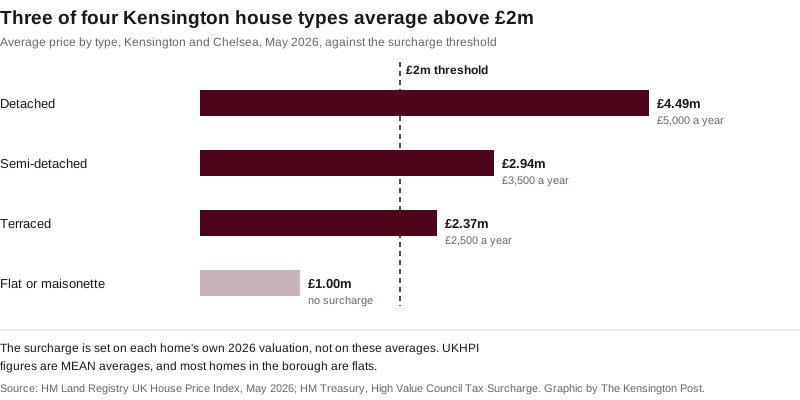
Land Registry figures for May 2026 put the borough average at £1,255,567, down 10.7% on a year earlier. Split by property type, three of the four averages sit above the threshold:
- Detached: £4,492,408. In the £3.5m to £5m band, so £5,000 a year.
- Semi-detached: £2,942,399. In the £2.5m to £3.5m band, so £3,500 a year.
- Terraced: £2,367,693. In the £2m to £2.5m band, so £2,500 a year.
- Flats and maisonettes: £1,000,463. Below the threshold.
Two caveats matter. The surcharge is assessed on each home’s own 2026 valuation by the Valuation Office, not on an area average, so no individual bill can be read off this chart. And the UK House Price Index is a mean average, not a median, so a small number of very expensive sales pull it up. Most homes in this borough are flats, and the flat average is half the threshold.
Full figures are on our Kensington house prices page.
If you cannot pay it
The government is consulting on a deferral scheme rather than an exemption. Its proposal, as published, is that you could defer if your household has:
- an annual income of £35,000 or less, and
- capital savings of £16,000 or less.
Deferral would be available on a main home only, not a second home, and not to companies. The deferred amount would accrue interest and be secured against the property, provided there is enough equity to cover it. Payment falls due when the property is disposed of. Deferral may also be available where the home is the main residence of someone who is disabled or severely mentally impaired. (MHCLG, High Value Council Tax Surcharge: consultation)
The consultation ran for eight weeks, from 19 May to 14 July 2026. It has closed. The government has not yet published its response.
What the four councils are asking for
The leaders’ letter to the Chancellor makes three arguments:
- Calling it a council tax surcharge is “disingenuous” when none of the money stays with the local authority. Councils collect it on behalf of central government.
- The deferral limit is too low. The councils say £35,000 is below the average salary in London, and that a couple on the London Living Wage could be caught by the charge.
- Councils need clear guidance on how the government intends the policy to be implemented.
Cllr Elizabeth Campbell, the leader of Kensington and Chelsea Council, said the measure “is not a tax carefully targeted at the very wealthy” and that it “will hit pensioners, families and long-standing residents whose homes have risen in value while their incomes have not”.
She added: “The Government is calling this a council tax surcharge, but our council will not keep a penny of it for local services.”
In their joint letter the four leaders wrote: “A home is the centre of family life, not an untapped tax stream. Our residents have often lived in the same home for decades.”
What it means for you
If you own a home in the borough, the thing that decides whether you pay is the Valuation Office’s assessment of its 2026 value, not what you paid for it and not what your neighbour’s sold for. That exercise has not happened yet.
If you rent, you are not liable. The charge falls on the owner. Westminster’s leader has raised the possibility of landlords passing costs through in rents, which is a risk rather than a rule.
If you are a long leaseholder, the government’s position in the consultation is that some leaseholders will be liable, because a long lease is a form of legal ownership.
Nothing is payable yet. The first bills are due in 2028, and the government has still to publish its response to the consultation and its final rules on reliefs, exemptions and complex ownership through companies, funds, trusts and partnerships.
Sources
- High Value Council Tax Surcharge, HM Treasury, published 26 November 2025 for the bands, the £2m threshold, the 2026 valuation basis, the April 2028 start, the £430 million estimate, the under-1% figure and the band D comparison.
- High Value Council Tax Surcharge: design and delivery, Ministry of Housing, Communities and Local Government for the deferral proposals, the £35,000 and £16,000 thresholds, the leasehold position and the consultation dates.
- More than half of ‘mansion tax’ to come from just four London boroughs, Royal Borough of Kensington and Chelsea, 6 August 2026 for the £270 million estimate, the letter’s three arguments and the quotes from the council leaders.
- UK House Price Index, Kensington and Chelsea, May 2026, HM Land Registry for the borough average and the averages by property type.
Have your say