
The full band A to H table for Kensington and Chelsea, fifth cheapest of 33 London boroughs. Plus the 47 garden squares that add up to £652 on top.
A band D home in Kensington and Chelsea pays £1,643.44 this year. That is the fifth cheapest of the 33 London boroughs. On the comparable area measure, which includes the garden square levies, the borough is £401.35 below the London average.
It can also be wrong for your street by more than £650, because 47 garden squares in the borough add a levy on top. The full tables are below.
The band A to H table for 2026/27
| Band | Kensington and Chelsea | Greater London Authority | Total |
|---|---|---|---|
| A | £755.29 | £340.34 | £1,095.63 |
| B | £881.17 | £397.06 | £1,278.23 |
| C | £1,007.05 | £453.79 | £1,460.84 |
| D | £1,132.93 | £510.51 | £1,643.44 |
| E | £1,384.69 | £623.96 | £2,008.65 |
| F | £1,636.45 | £737.40 | £2,373.85 |
| G | £1,888.22 | £850.85 | £2,739.07 |
| H | £2,265.86 | £1,021.02 | £3,286.88 |
Source: RBKC, council tax for 2026 to 2027. Every row adds up and the band ratios are correct against band D.
Only two bodies charge in this borough. There is no county council, no separate police or fire precept and no parish council anywhere in Kensington and Chelsea. The council keeps its share; the Greater London Authority’s share funds the Metropolitan Police, the London Fire Brigade and Transport for London.
What went up, and by how much
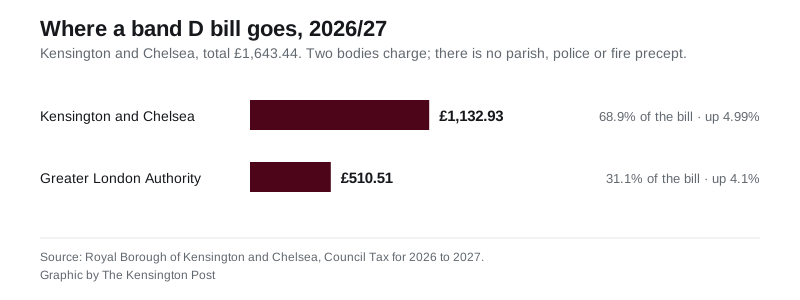
The council raised its own share by 4.99 per cent, which is £53.85 at band D. That is made up of a 2.99 per cent rise in the main element and a 2 per cent adult social care precept, and it sits just under the 5 per cent threshold that would have forced a referendum.
The GLA share rose 4.1 per cent, or £20.13 at band D.
The council also makes a point that catches people reading old bills: the social care precept is no longer shown separately, so to work out the rise you take last year’s figure and apply 4.99 per cent to the whole thing.
How that compares across London
Only Wandsworth, Westminster, the City of London and Hammersmith and Fulham charge less. Kensington and Chelsea’s area average band D is £1,666.65, which is £401.35 below the London average of £2,068 and £725.35 below the England average of £2,392.
| Rank | Borough | Area average band D |
|---|---|---|
| 1 | Wandsworth | £1,028.21 |
| 2 | Westminster | £1,049.55 |
| 3 | City of London | £1,329.56 |
| 4 | Hammersmith and Fulham | £1,519.51 |
| 5 | Kensington and Chelsea | £1,666.65 |
Source: MHCLG, council tax levels set by local authorities in England 2026 to 2027, Table 10, column 17. The dearest London borough is Kingston upon Thames at £2,609.20, which is £942.55 more than here.
That £1,666.65 is £23.21 higher than the £1,643.44 on the council’s own table. The difference is the garden square levies, which MHCLG spreads across every home in the borough. Almost nobody actually pays £1,666.65. You either pay £1,643.44 or you pay considerably more.
The 47 garden squares, and what they add
If your home surrounds one of the borough’s private garden squares, the council is required to collect a levy for it as part of your council tax. The garden committees set the amount each year, not the council, and the council collected levies totalling £2,471,916 for 2026/27.
The gap between squares is enormous. At band D equivalent, the charge runs from £55.96 on Ladbroke Grove to £652.26 on Clarendon Road and Lansdowne Road. The latter turns a £1,643.44 bill into £2,295.69, higher than the area average band D in 24 of London’s 33 boroughs.
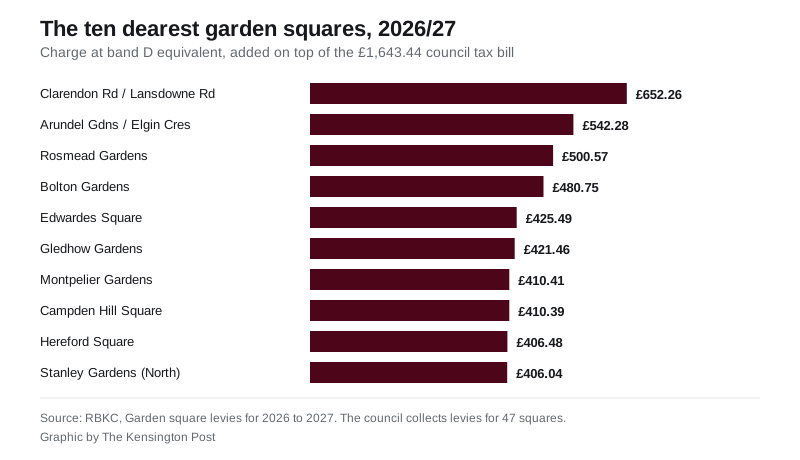
The largest levy in cash terms is not the largest per household. Arundel Gardens and Elgin Crescent raises £160,000 across 277.50 band D equivalent dwellings, while Edwardes Square raises £106,181 across 248.70, and the £3,000 levy at Ladbroke Grove is the smallest of the 47. What each household pays depends on how many homes share the square.
At the other end, the cheapest squares to live beside are Ladbroke Grove (£55.96), Emperor’s Gate (£60.94), Iverna Court (£79.92) and Ashburn Place and Wetherby (£85.30).
The council’s full table lists every square with its levy, its tax base and the band D charge. Every row we checked reconciles against the £1,643.44 base. (RBKC, garden square levies for 2026 to 2027; levies queries on 020 7361 3276)
Your bill arrived late this year, and it was not a mistake
The council was hit by a cyber attack in late November 2025 that took its Revenues and Benefits systems offline. Council tax collection stopped altogether for months.
The consequences are still running:
- Billing for 2025/26 resumed in March 2026. The council issued around 26,000 bills that month, took just under 25,000 payments and collected over £12 million, and identified roughly 1,500 households likely to need extra help.
- The 9,000 households on full Council Tax Reduction were not billed and were not affected.
- The 2026/27 annual bills went out in May, not March. Instalments therefore start in June, so monthly payers get ten instalments from June to March rather than twelve. Quarterly payers pay in June, September, December and March.
- Bills issued do not include changes reported since November 2025. The council says it will send revised bills afterwards where needed and that no further contact is required if you have already told it.
- Discount and exemption applications are being emailed in and processed once the systems are restored, rather than decided now.
(RBKC, council tax being collected again following November 2025 cyber attack; RBKC, council tax bills for 2026 to 2027)
The council tax team is on 020 7361 3005.
Empty homes and second homes: the premiums bite here
In a borough with this much unoccupied property, the premiums are the part of the council tax rules that costs the most money.
From 1 April 2026 a second home that is empty and furnished carries a 100 per cent premium. The bill is double the band charge, and it continues until the property is occupied, sold or let. At band H that is £6,573.76 a year rather than £3,286.88.
Long-term empty homes escalate:
| Empty for | Premium | Total bill |
|---|---|---|
| Less than 1 year | Nil | 100% |
| 1 to 5 years | 100% | 200% |
| 5 to 10 years | 200% | 300% |
| Over 10 years | 300% | 400% |
Source: RBKC, council tax empty properties.
Exceptions exist and have to be claimed with evidence. The two most commonly used are Class G, a property actively marketed for sale, and Class H, actively marketed for rent, each capped at 12 months and each needing a letter or contract from the agent plus written authority for the council to contact them. Class E covers armed forces accommodation and Class F annexes. The council warns that you remain liable for the premium as billed while a claim is being considered.
A separate change is coming that will matter far more here than in most boroughs. From April 2028 the government’s high value council tax surcharge adds £2,500 to £7,500 a year on homes worth £2 million or more, and Kensington’s average terraced house is already above that line. We have covered that in Kensington mansion tax: £2,500 to £7,500 a year from 2028.
Discounts
- Single person: 25 per cent off. Count the adults living there as their main home, excluding anyone in a disregarded group. If one remains, the bill drops by a quarter. Extra adults beyond two do not increase the bill.
- If everyone in the household is disregarded, a 50 per cent discount may apply instead.
- Disregarded people include full-time students, student nurses, apprentices, people who are severely mentally impaired, people in hospital or residential care, live-in carers other than a spouse, partner or child under 18, monks and nuns, and convicted prisoners other than those jailed for non-payment of fines or council tax.
- Households of only full-time students pay nothing (exemption Class N), as do halls of residence (Class M) and homes occupied only by people who are severely mentally impaired (Class U) or only by under-18s (Class S).
- Care leavers under 25 who live in the borough have been exempt since 1 April 2018 and get a zero bill.
- Disabled band reduction: if the home has an extra bathroom, kitchen or room mainly used by a disabled resident, or space for indoor wheelchair use, the bill drops to the band below. Band A properties still get a reduction, worth the same in cash as the B to D reduction.
(RBKC, council tax discounts, exemptions, disabled relief scheme and care leavers)
Council Tax Reduction, if you are on a low income
The maximum award depends on which benefit you are on:
- Pension Credit Guarantee, with nobody else living with you: up to 100 per cent reduction
- Income-based JSA, income-related ESA, Income Support, or Universal Credit as your only income, with nobody else living with you: up to 90 per cent
- Universal Credit while working: calculated on a banded income scheme
Capital above £16,000 normally rules you out, though 10 per cent of a capital asset’s value is disregarded where there is a cost to disposing of it. Full-time students only qualify if they fall into a government vulnerable group, which includes single parents, disabled students and pensioners.
There is also an alternative Council Tax Reduction for people whose own income or savings are too high, but who share their home with someone over 18 on a low income who pays no rent, is not liable for council tax and is not their partner. Applications on 020 7361 3006. (RBKC, council tax reduction)
Checking and challenging your band
Bands are set by the Valuation Office Agency on what the property was worth in 1991, not today. You can look up your band, or any other property’s, at gov.uk/council-tax-bands.
You cannot appeal simply because the market has moved. The grounds the council lists are:
- building or engineering work changed the value, in which case revaluation normally follows a sale and the appeal comes from the new owner or resident
- the value fell through partial demolition, a change in the surroundings, or adaptation for someone with a physical disability
- a house was converted to flats or flats back to a house
- the Valuation Officer changed the band, in which case you have six months to appeal
The route is gov.uk/challenge-council-tax-band, or the VOA on 03000 501 501. Keep paying at your current band while an appeal is decided. Appeals about liability, rather than banding, go to the council in writing.
Have your say