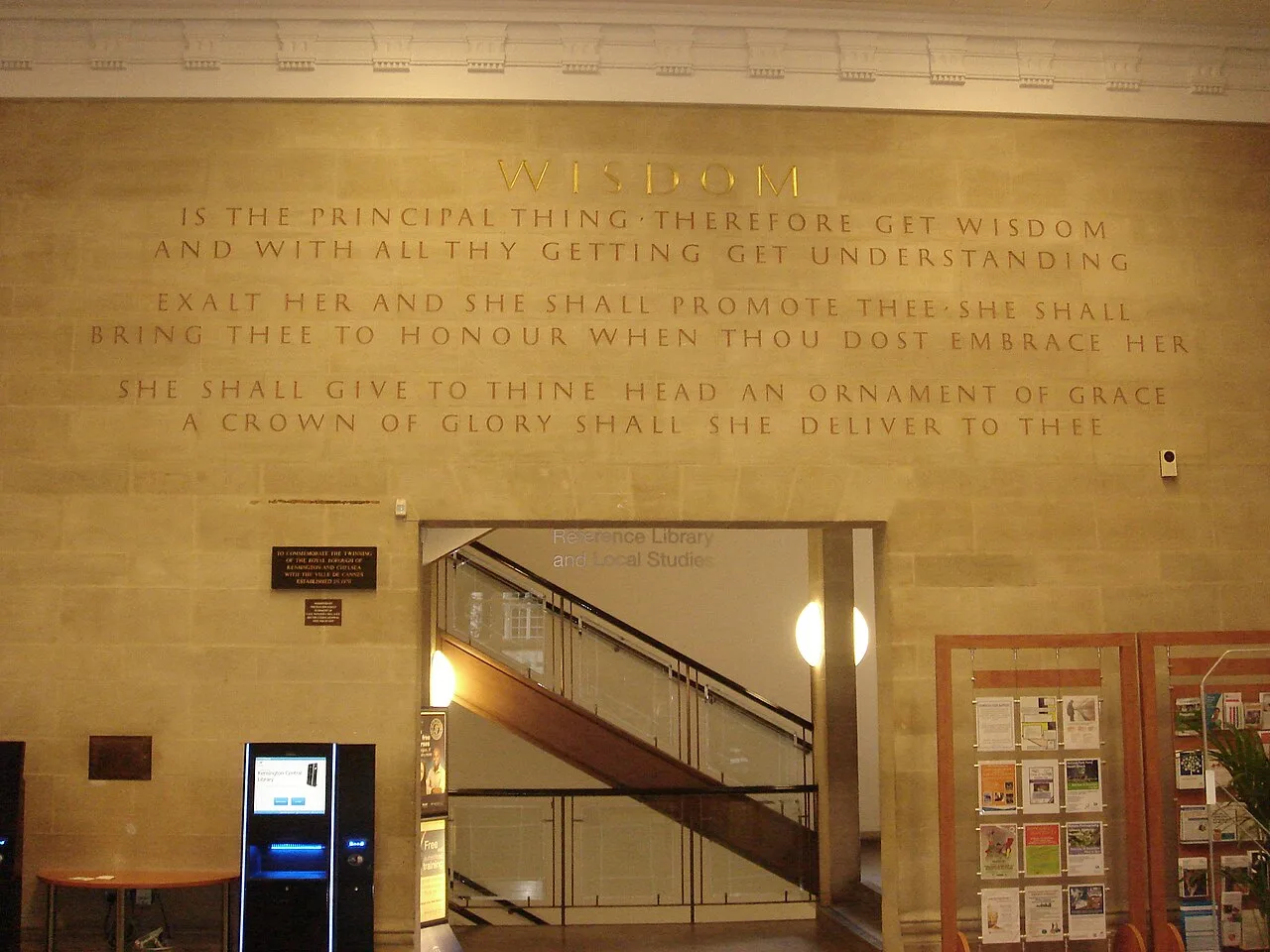

Letters a Kensington Regiment soldier sent home from five years as a prisoner of war go on display at Kensington Central Library from 3 to 30 November.
The letters a Kensington Regiment soldier wrote home through five years as a prisoner of war, kept all that time by his mother, are going on public display at Kensington Central Library through November.
Flown Home by Lancaster tells the story of Staff Sergeant Desmond Thain, who was captured at St Valery en Caux in June 1940 and spent the rest of the war in German camps working as an interpreter. It runs in the Archives and Local Studies Search Room on Phillimore Walk from Tuesday 3 November to Monday 30 November, open on Tuesdays from 1pm to 5pm and on Wednesdays from 10am to 5pm, according to the press release from Princess Louise’s Kensington Regimental Association.
The association (PLKRA) is putting on the display with his family. “Our association (PLKRA) is working with the Thain Family on this display,” its historian, Ray Tattle, told The Kensington Post.
From Hammersmith to Stalag XX-B
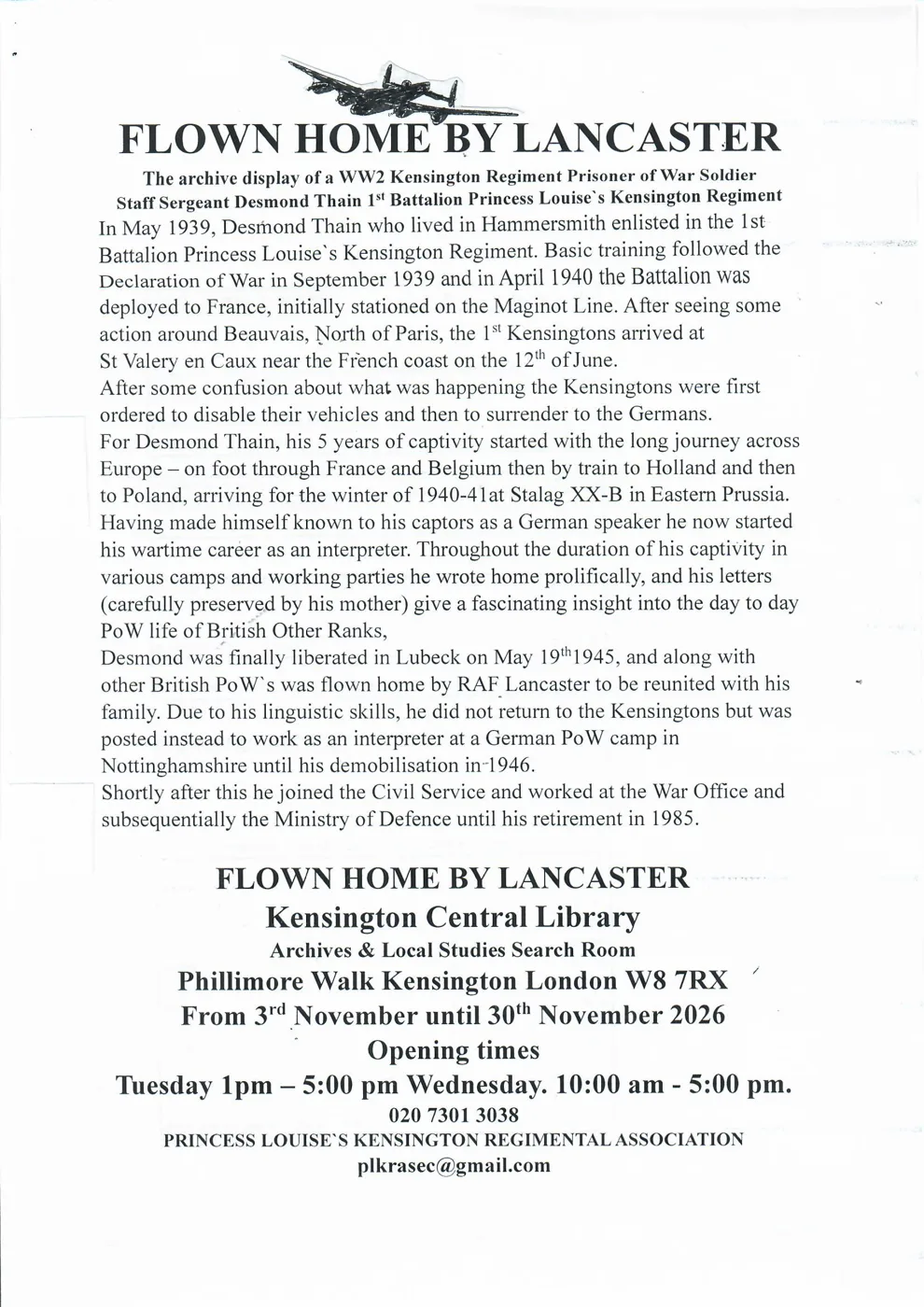
The family’s synopsis, set out in the association’s press release, follows him from the start. Desmond Thain lived in Hammersmith and enlisted in the 1st Battalion, Princess Louise’s Kensington Regiment, in May 1939. Basic training followed the declaration of war that September, and in April 1940 the battalion was sent to France, “initially stationed on the Maginot Line”.
“After seeing some action around Beauvais, North of Paris, the 1st Kensingtons arrived at St Valery en Caux near the French coast on the 12th of June,” the release says. “After some confusion about what was happening the Kensingtons were first ordered to disable their vehicles and then to surrender to the Germans.”
What came next was a long march into captivity. “For Desmond Thain, his 5 years of captivity started with the long journey across Europe, on foot through France and Belgium then by train to Holland and then to Poland, arriving for the winter of 1940-41 at Stalag XX-B in Eastern Prussia.”
There he made himself known to his captors as a German speaker, and, in the release’s words, “he now started his wartime career as an interpreter”.
The letters his mother kept
The letters are the heart of the display. “Throughout the duration of his captivity in various camps and working parties he wrote home prolifically, and his letters (carefully preserved by his mother) give a fascinating insight into the day to day PoW life of British Other Ranks,” the release says.
The association’s own report on the archive lists a manuscript by Desmond Thain alongside the letters.
He was liberated in Lübeck on 19 May 1945 “and along with other British PoW’s was flown home by RAF Lancaster to be reunited with his family”, which gives the display its name. He did not go back to the Kensingtons. “Due to his linguistic skills,” the release says, he was posted instead “to work as an interpreter at a German PoW camp in Nottinghamshire until his demobilisation in 1946”. He then joined the Civil Service, working at the War Office and later the Ministry of Defence until he retired in 1985.
How the archive reached the regiment
The association’s report sets out how the display came about. Philip and Eleanor Thain presented the archive of the late Staff Sergeant J D Thain, which the report describes as material from his service with the 13th London, Princess Louise’s Kensington Regiment, between 1939 and 1945, to the association at the Union Jack Club in London on 1 September 2026. The association’s honorary secretary, Rob Watson, and Mr Tattle attended for the PLKRA, and the meeting was about passing the archive into the association’s safe keeping and “how the archive can be presented to a wider audience”.
Mr Tattle asked Philip Thain, Desmond’s son, for a synopsis of his father’s story so he could propose a November display to the library. The report says the proposal was approved by Sophia Hall, the Royal Borough of Kensington and Chelsea’s archivist, “to whom the PLKRA are incredibly grateful”. Philip Thain is working with her on what goes on show and on getting the archive to and from the library.
What happens after November
The display is the archive’s first public outing, and the association’s report lists what it plans next:
- After the display closes, all of the material is to be catalogued and scanned for digital storage.
- The association will look at putting the paperwork online through the PLKRA website, and, “if this is possible”, setting up an educational base.
- Once its website has been rebuilt, it proposes a rolling page called Kensington Remembered, with an overview of the archive and a link to the digital collection.
- Once the originals are scanned, it will consider whether the archive’s home should be Kensington Library or ARC Coulsdon, where the PLKRA archive is held.
- Mr Watson is to plan what material he needs for a presentation to 31 MX Signal Squadron PLK, date to be announced.
- Association members are checking whether Desmond Thain appears in any regimental group photograph in the PLKRA archive at ARC Coulsdon.
There may be a book too. Mr Tattle has put Philip Thain in touch with the author David Wilkins so that the two of them can look into producing a book that would bring together Desmond Thain’s manuscript and his letters, the report says. Mr Wilkins wrote The Longest Walk Home, the story of another Kensington soldier, Raymond Bailey, who the association says was, like Desmond Thain, captured at St Valery, and who made a 2,000-mile escape home.
What it means for you
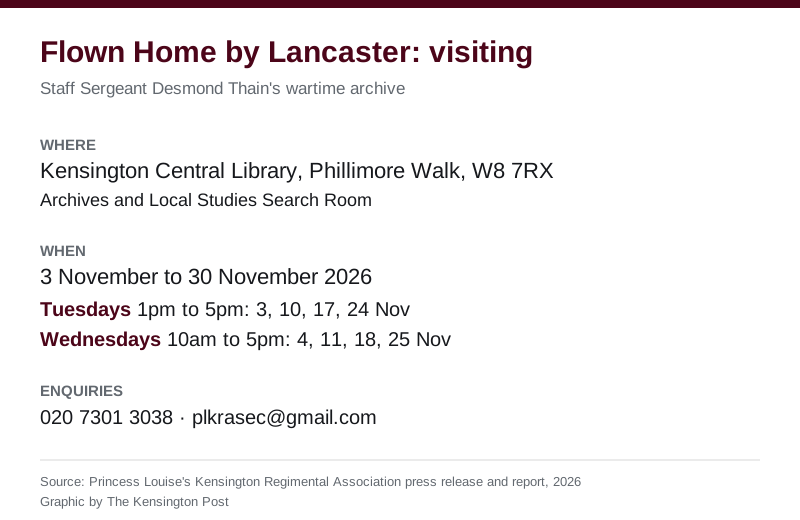
- Where: Archives and Local Studies Search Room, Kensington Central Library, Phillimore Walk, London W8 7RX.
- When: 3 to 30 November 2026. The room is open for the display on Tuesdays, 1pm to 5pm (3, 10, 17 and 24 November), and Wednesdays, 10am to 5pm (4, 11, 18 and 25 November). There are no other days listed.
- Enquiries: the release gives 020 7301 3038, and the association’s email, plkrasec@gmail.com.
- The release does not mention a charge or booking; ring the number above if you want to check before you go.
The display opens five days before Remembrance Sunday on 8 November; our guide has the times of the services at the Kensington and Sloane Square war memorials. Kensington Central Library is also one of the venues in the council’s libraries and archives consultation, which closes on 17 November.
Have your say