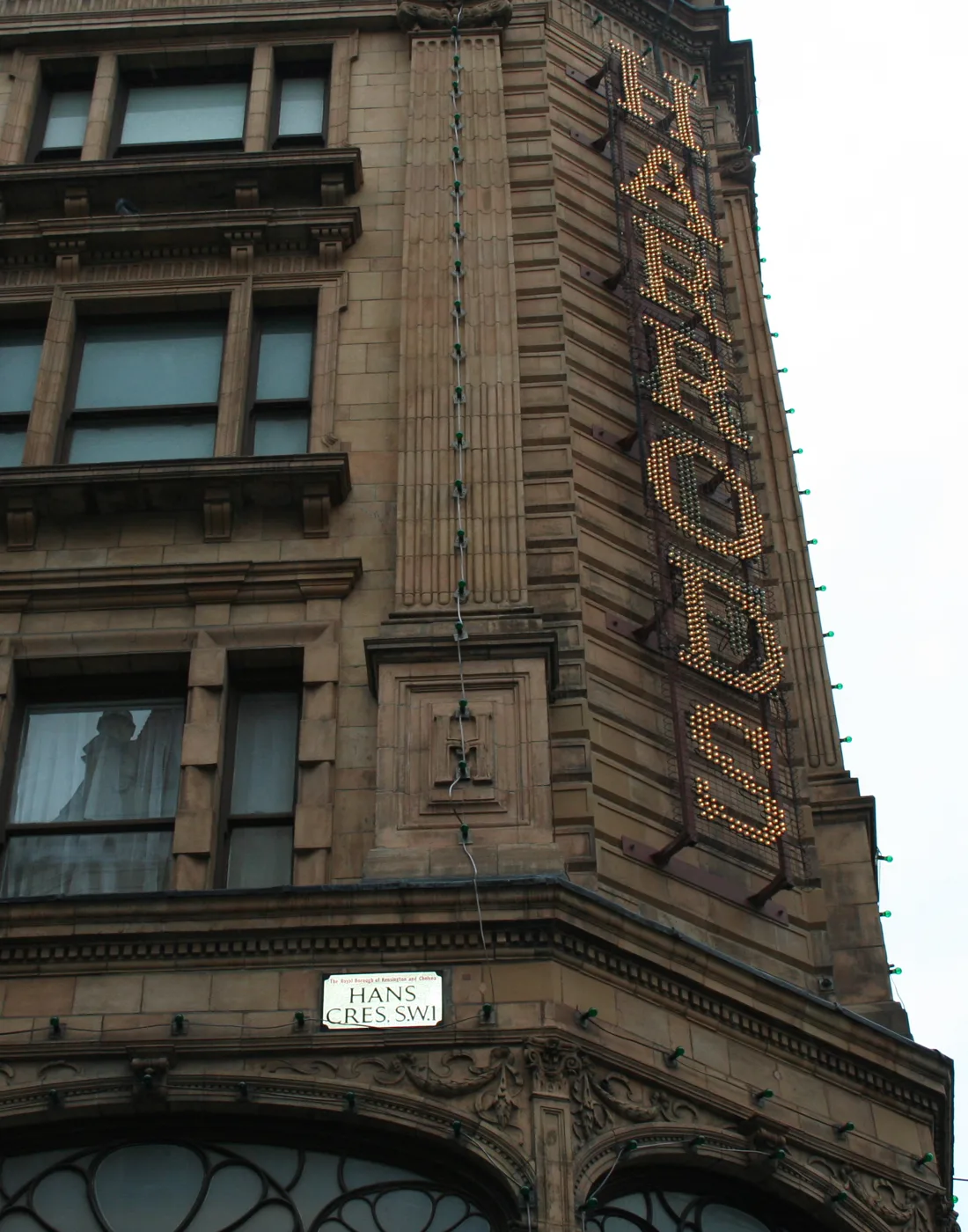

Work has started on Hans Crescent outside Harrods, finishing autumn 2026. Ward councillors put in £320,000; nine of the 20 the council asked said no.
Builders have moved on to Hans Crescent, the pedestrianised street between Harrods and the Knightsbridge Estate, for a scheme that will finish in autumn 2026.
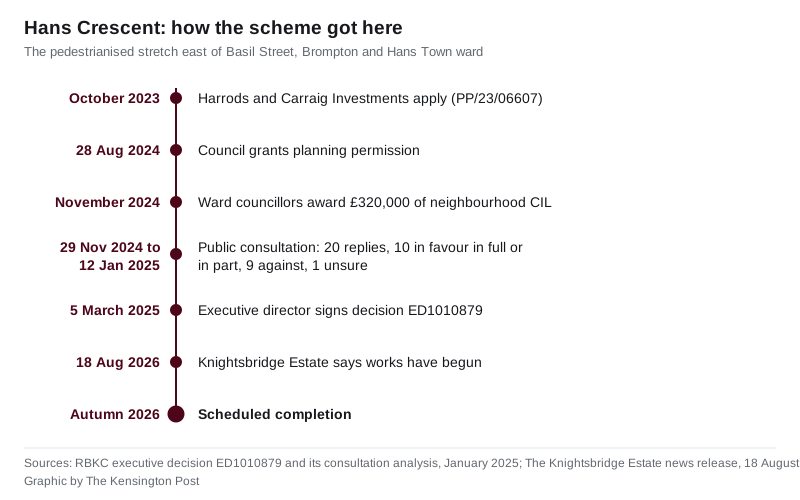
The Knightsbridge Estate said on 18 August that it and Harrods have “commenced works on a joint improvement scheme for Hans Crescent”, designed by Andy Sturgeon Design. (The Knightsbridge Estate) The same practice says it is leading the Sloane Street transformation “in collaboration with Cadogan, the Royal Borough of Kensington and Chelsea, and John Macaslan & Partners”. (Andy Sturgeon Design)
The announcement is short and does not mention two things the council’s own paperwork does. Kensington and Chelsea ward councillors put £320,000 of public money into the scheme. And when the council asked residents, businesses and visitors whether it should go ahead, nine of the 20 who replied said it should not.
What is being built
The approved layout is set out in the executive decision report signed off by the council in March 2025. The scheme covers Hans Crescent east of Basil Street and consists of:
- new paving down the centre of the street, in a banded pattern running across it, replacing the small-unit paving and circular patterns laid in 2009
- six raised planters with seating built into the surrounding walls
- five freestanding natural stone seats
- one tree removed, four kept in grilles inside the planters, and three new trees planted towards the Basil Street end
- the existing lamp columns replaced with heritage style ones
- a drop-off area for taxis and other vehicles next to Basil Street
- a patch of paving left clear so artworks can be installed there later, subject to separate approvals
(Royal Borough of Kensington and Chelsea, executive decision ED1010879)
The terraces in the middle of the street go
The part of the scheme that changes how the street is used is not in the Knightsbridge Estate’s announcement at all.
Since 2020, outdoor dining terraces have been licensed in the central part of Hans Crescent, away from the shopfronts, under the pavement licence rules brought in by the Business and Planning Act 2020. When the decision report was written in February 2025, four were licensed and operating there: L’Eto, Elan, Crazy Pizza and Harrods.
The council’s own report is blunt about why that is ending. “The documentation supporting the planning application affirms that one of Harrods’ objectives is to remove the temporary terraces from the centre of the street,” it says. “Harrods consider the temporary terraces to detract from the visual appearance of the area.” Once the scheme is built, it will no longer be possible to license tables and chairs in the middle of Hans Crescent.
Terraces up against the buildings on the north-east side stay. The council caps those at 1.6 metres deep, so that a four metre clear width is kept for emergency vehicles, and says there is no real scope to widen them.
Who is paying
Harrods is paying for the works and doing them, under an agreement with the council made under section 278 of the Highways Act 1980. Council officers inspect during and after. Harrods also takes on the upkeep of the planters and the bespoke furniture, under a licence combining section 142 of the Highways Act 1980 and section 50 of the New Roads and Street Works Act 1991, so there is no new annual bill for the council. The council’s waste contractor will keep emptying the public bins.
The public contribution is £320,000 of neighbourhood Community Infrastructure Levy, the slice of developer levy money that ward councillors direct. The report records that Brompton and Hans Town councillors awarded it in November 2024, under a separate decision, ED5009029.
What the consultation actually said
The council ran a consultation between 29 November 2024 and 12 January 2025, promoted by a letter drop, emails to the street’s hospitality businesses and its own e-newsletters. Twenty surveys came back.
- four supported the scheme in full
- six supported it in part
- nine did not support it
- one was unsure
(Analysis of stakeholder consultation, January 2025)
Seven respondents were local residents, six were visitors and three were local businesses. Four answered in some other capacity: two taxi drivers, a membership organisation representing taxi drivers, the Knightsbridge business improvement district, and a representative of Harrods and Carraig Investments Sarl, who own the buildings on the other side of the street.
The two council documents do not quite agree on that breakdown. The decision report summarises the same survey as having four visitors rather than six, and its list adds up to 19 rather than 20. We have used the figures in the consultation analysis itself, which is the underlying document.
The commonest themes were split evenly: five comments in favour, five worried about traffic congestion. One respondent wrote that the planters “will increase that congestion” and that the street would be “very hard to navigate, especially for people in wheelchairs”. A taxi driver asked for clarity on what rank space would survive at the Basil Street junction, since the kerbside spaces by the Harrods door are used to load passengers in wheelchairs. Another wrote: “The Council should not be paying for this.”
The council’s answer, in the decision report, is that the scheme itself does not affect the nearby taxi ranks. It notes that an alternative junction layout put forward by the business improvement district’s design team would, in fact, mean reconfiguring the taxi ranking on Basil Street.
An earlier round, the statutory planning consultation in November 2023, drew a site notice, a London Gazette notice and letters to 172 nearby properties. One resident objected. The Knightsbridge Association supported it. Planning permission, reference PP/23/06607, was granted on 28 August 2024.
What it means for you
If you walk through Hans Crescent to the Tube, this is one of the main ways in to Knightsbridge station, and the works run until autumn. The street is already a restricted zone under the borough traffic management order: no waiting or parking at any time, and no servicing between 10am and 6pm. The Knightsbridge Estate says clear pedestrian routes will be kept through the street while work goes on, but it has not published a phasing plan, so allow extra time. Our Kensington roadworks and travel page tracks current closures, and Kensington tube and travel has fares and station details.
If you eat outside on Hans Crescent, the central terraces are the ones affected. The council said it would give businesses reasonable notice to clear their furniture before construction. Seating against the shopfronts is not affected, either during the works or after.
If you want to see the drawings, the approved layout and the general arrangement plans are appendices to decision ED1010879 on the council’s committee site. The named contact is James McCool, transport planning manager at the council.
If you want to object to something similar near you, the point at which this was decided in public was the planning application in late 2023, when 172 properties were written to and one person replied. Our Kensington planning news page lists what is currently open for comment.
Two things we could not confirm today from a first-party source: the date the works started on site, and whether the central pavement licences have already been surrendered or revoked. The pavement licences the decision report names were due to expire on 2 July, 23 September and 6 October 2025, so they may simply have run out. We will update this article if the council or Harrods publishes either.
Have your say