
1,499 people answered the council's funding survey and 93% backed a formal appeal to ministers over the £108m cut. Leaders decide on Tuesday 13 October.
Kensington and Chelsea Council’s leaders will decide on Tuesday 13 October whether to send ministers a formal appeal against the cut to its Government funding. The council says the change removes £108 million from its budget between 2026/27 and 2029/30.
The decision follows a month-long consultation. 1,499 people responded, and 93 per cent backed the appeal: 90 per cent strongly and 3 per cent in support. The council published the result on Tuesday 6 October (RBKC newsroom, 6 October).
The appeal itself will not change this year’s sums. The report to leaders says the council’s budget planning for 2027/28 “is continuing on the basis of the Fair Funding formula as currently published”, and that there is “no guarantee” the appeal brings in any more money (key decision report KD1014784).
What leaders are being asked to agree
The recommendation to the Leadership Team is one line: submit a proposal under the Sustainable Communities Act 2007 asking the Government “to provide alternative funding solutions to its Fair Funding formula”.
The report sets out the council’s case:
- the formula removes £108 million over 2026/27 to 2029/30, which the council puts at more than 40 per cent of its controllable budget
- with inflation and demand added, the council’s budget gap is £127 million over 2027/28 to 2030/31, the figure leaders were shown in July
- the formula does not reflect the borough’s housing costs or its population density, the fourth highest in London
- the council “should not be penalised” for keeping council tax low
The meeting is in Committee Room 1 at Kensington Town Hall at 6.30pm (agenda, Leadership Team, 13 October). The same agenda carries the adoption of the new Council Plan for 2026 to 2030.
The Act does not allow boroughs to submit joint proposals. The report says Westminster, Richmond upon Thames and Wandsworth, which face comparable reductions, will each submit their own. The council’s news release names only Westminster and Wandsworth.
What the 1,499 people said
The full consultation report was published with the decision papers (consultation report, October 2026). Asked to rank four priorities for any appeal, respondents put “keep a greater share of locally generated income, such as business rates, stamp duty and income tax” first, with a mean score of 3.38 out of 4. More time to adapt to the change came second, at 2.25.
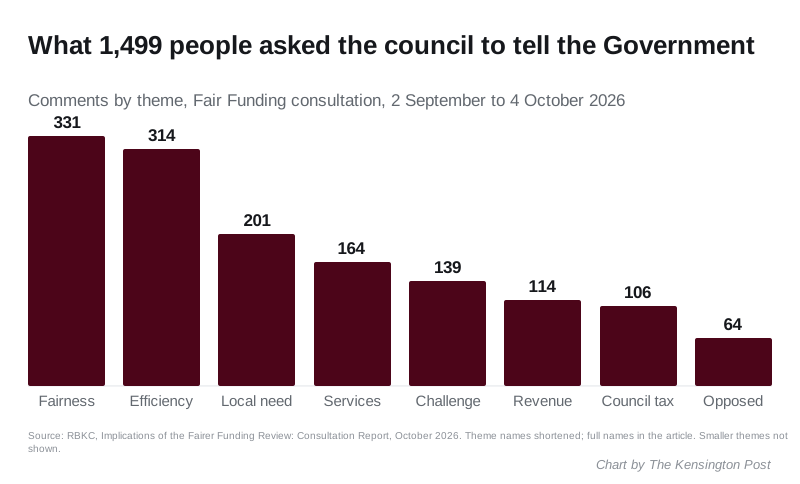
People were also asked what the Government should do. The council grouped the comments into themes. The largest were:
- fairness, scale of cuts and rewarding efficient councils: 331 comments
- efficiency, accountability and public-sector spending reform: 314
- local need, deprivation and protection of vulnerable residents: 201
- specific services and exceptional cost pressures: 164
- legal, political and collective challenge to Government: 139
- local economic autonomy, alternative revenues and growth: 114
- council tax, property taxation and household affordability: 106
- opposition to the council’s approach and criticism of its performance: 64
The comments pull in different directions on council tax. Some respondents argued that a valuable home does not mean a high income, particularly for pensioners and long-standing residents. Others asked the council to raise council tax, or to charge more on the most expensive homes. The council’s report quotes both.
Who answered
The survey was not a poll of the borough, and the report’s own profile shows it:
- half the respondents were 65 or older, and only 9 per cent were 44 or younger
- 11 per cent of responses came from Royal Hospital ward in Chelsea, 9 per cent from Redcliffe and 8 per cent from Abingdon
- 1,417 of the 1,428 people who gave a full postcode live in the borough
The two council documents also differ on the opposition. The decision report says 5 per cent opposed the appeal. The consultation report says 6 per cent “strongly oppose” or “oppose”. Both say some of those comments appear to oppose the Government’s reforms rather than the council challenging them.
The consultation report also says the council used a large language model to help group the comments, and that a council officer read every comment and checked the themes.
What happens next
If leaders agree, the proposal goes to the Secretary of State, who must consider it and give reasons for the decision. If it is refused, the report says, the council can ask the Local Government Association to put it to the minister again. The submission itself costs nothing beyond staff time, the report says.
The Government gave its own reason for the change when it set the formula. It pointed to councils whose funding is well above what the formula says they need and whose council tax is below the average. That side of the argument, and what the cut has already meant for this year’s budget, is in our story on the consultation’s launch.
What it means for you
- Nothing changes on your bill yet. The 2026/27 council tax is set. Your band and this year’s charge are on our council tax page.
- The 2027/28 budget is being planned on the cut as it stands. This year’s budget was approved in February 2026.
- The decision is on Tuesday 13 October. It is a public item, and the papers are on the council’s committee pages.
Sources: Royal Borough of Kensington and Chelsea, “Almost 1,500 people respond to our Fair Funding consultation”, 6 October 2026; key decision report KD1014784, “Removing barriers through the Sustainable Communities Act”, for 13 October 2026; “Implications of the Fairer Funding Review: Consultation Report”, October 2026.
Have your say