
The council says it loses £108m over four years and wants residents behind its appeal by Sunday 4 October. Ministers give a different reason.
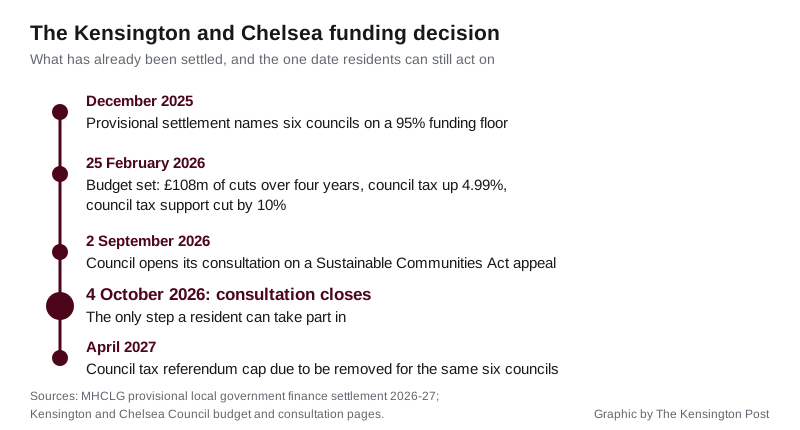
Kensington and Chelsea Council has opened a consultation asking residents to back a formal appeal against the Government’s funding settlement. It closes at the end of Sunday 4 October, and it is the only part of this process a resident can actually take part in.
The council’s case is that the Government’s Fair Funding Review removes more than £100 million from its budgets over the four-year funding period, “equivalent to over 40 per cent of our controllable budget”. That is the wording on the council’s own consultation page, which opened on 2 September. When the council set its budget in February it put the figure at £108 million.
What the council is actually asking for
The council wants to use the Sustainable Communities Act 2007. The Act lets a council put a proposal to central government to remove laws, policies or other barriers that stop it improving the economic, social and environmental wellbeing of its area.
To use it, the council has to show that its residents agree. That is what the consultation is for. The proposal itself asks the Government to “ensure that future funding arrangements better reflect the needs of Kensington and Chelsea and its residents”.
Cllr Elizabeth Campbell, the leader of the council, said in the announcement on 3 September:
“The Government’s so-called Fair Funding Review will strip over £100 million from this Council over four years. The consequences will fall on residents: cuts to services and tax rises forced upon them, entirely as a result of decisions taken in Whitehall, not this Town Hall. I am not prepared to let that happen without a fight.”
She said the council is acting alongside Westminster and Wandsworth, the two neighbouring boroughs in the same position.
What the Government’s own papers say
The council’s release does not explain why the money is being taken, so it is worth reading the documents on the other side.
The Government’s response to the Fair Funding Review 2.0 consultation sets out the mechanics. Councils are being moved to their new “Fair Funding Assessment” allocations in increments of one third across the three-year settlement, and authorities losing money get a floor under them. Most keep 100 per cent of their 2025-26 income. A smaller group does not:
“For upper tier authorities which are 15% or more above their Fair Funding Assessment, and which have council tax levels below the average, we will protect 95% of their 2025-26 income through a funding floor.”
Kensington and Chelsea is in that group. So the Government’s position is that the borough has been funded at least 15 per cent above what the new needs formula says it requires, and that it has below-average council tax.
The provisional settlement published in December names the councils concerned:
“The authorities that meet these criteria are City of London, Hammersmith and Fulham, Kensington and Chelsea, Wandsworth, Westminster and Windsor and Maidenhead.”
The same document adds a figure that goes to the heart of the argument: “Band D taxpayers in these councils are paying between £450 and £1280 less than the average in England.” A band D home here pays £1,643.44 this year, and you can see how that breaks down on our Kensington council tax bands page.
There is a second half to the Government’s decision that has had far less attention locally. Ministers propose not setting council tax referendum principles for those same six authorities in 2027-28 and 2028-29. In plain terms, the cap comes off. From April 2027 this council could in principle raise council tax by any amount without holding a referendum. The GLA, fire and police parts of the bill stay capped.
So when the council warns of “tax rises forced upon them”, the mechanism that would allow a large rise here is the one the Government has just handed it.
What has already happened to your bill
The consultation is about a future appeal. The decisions taken on the back of this settlement have already landed. At Full Council on 25 February the council approved a 2026/27 budget containing:
- a 4.99 per cent council tax increase
- a 100 per cent second homes premium
- a 10 per cent cut to council tax support
- £21 million of savings from staff voluntary redundancy, building efficiency and advertising income
The council tax support change is the one that falls on the lowest incomes. The council put it plainly: “people currently receiving 100 per cent relief on their bill will now receive 90 per cent relief.” Councillors agreed it on 28 January 2026, after a separate consultation that ran from 27 October to 7 December 2025 and drew 546 responses.
The same budget also committed £4.4 million to Portobello Road, £8 million to parks and green spaces, £1 million more to street cleaning and £700,000 to cleaner streets, inside a capital programme of over £200 million across five years.
What it means for you
If you want a say, the deadline is real and it is close. The consultation runs to Sunday 4 October at consult.rbkc.gov.uk. Print, easy read and other-language versions are available from the council’s consultation team by email at consult@rbkc.gov.uk.
Be clear about what your answer does. This is not a vote on the funding settlement, and it will not change the money the council receives in 2026/27. It is evidence the council needs before it can submit a Sustainable Communities Act proposal, and the Government is under no obligation to accept that proposal.
The decision worth watching is the next one. Because the referendum cap is due to be lifted here from April 2027, the size of your 2027/28 bill will be set by councillors and not by a Whitehall limit. If the appeal fails, that is the lever left. Our council tax bands page shows what each band pays now, and the Kensington planning news and bin collection days pages cover the services this budget funds.
If you are one of the households that had 100 per cent council tax relief until this year, check your bill. The 10 per cent change took effect for 2026/27, and the council’s annual bills for this year went out in May rather than March.
Sources: Royal Borough of Kensington and Chelsea, “Help us challenge the Government’s Fair Funding cuts”, published 3 September 2026; the council’s consultation “Implications of the Fairer Funding Review”, open 2 September to 4 October 2026; “Council approves a forward-looking budget for 2026 to 2027”, published 26 February 2026; MHCLG, “Provisional local government finance settlement 2026 to 2027”, paragraphs 3.1.3, 4.2.3, 4.2.4 and 4.2.5; and MHCLG, “Government response to the Fair Funding Review 2.0”, paragraphs 9.4.12 and 9.4.13.
Have your say