
Kensington and Chelsea will fund a three-year pay deal for its parking wardens to head off a repeat of the 2023 strike. The cost is exempt from publication.
Kensington and Chelsea has agreed to put council money into a private contractor’s wage bill to stop its parking wardens walking out.
In a key decision published on 23 September, Councillor Josh Rendall, the lead member for transport, parks and clean streets, approved varying the council’s two contracts with NSL Limited “such that NSL are financially supported… sufficient to reach a three-year pay deal with the staff they employ to enforce on-street parking restrictions in RBKC”.
How much that will cost the council is not published. The figure sits in a Part B appendix, exempt under paragraph 3 of Schedule 12A of the Local Government Act 1972 on the grounds that it concerns the financial or business affairs of a particular person.
The council was not the first to know there was a problem. The report behind the decision, dated 22 September, opens by saying the council “has been alerted by its enforcement contractor, NSL, of an emerging risk of pay-related industrial action”, and warns that failing to resolve it “is likely to lead to parking enforcement activity reducing to a level whereby the Council would fail to meet its statutory network management duty”.
No strike has been called. The GMB union has put in what the report calls “a substantial pay claim” for 2026, NSL has rejected it on affordability grounds, and officers judge there is “a high likelihood that the dispute could escalate to industrial action unless a resolution is reached quickly”.
This has happened here before
The report is unusually direct about why the council is not waiting to find out.
In 2023, a pay dispute over enforcement staff in Kensington and Chelsea being paid less than in some other inner London boroughs led to industrial action. The report’s account of what followed is two sentences long: “much reduced enforcement activity and a significant adverse budget pressure for the Council.”
The council’s answer then was the same as its answer now. It varied the NSL contract so it could help fund a three-year pay settlement. That settlement has now run out, which is what has brought the dispute back.
Officers set out five options, and rejected four of them:
- Do nothing. NSL says settling the claim is unaffordable under the contract as it stands, so this carries “a very high risk of industrial action, service disruption and budgetary pressure” until the contract ends in July 2028.
- Start reprocuring the service now. The dispute stays unresolved until early 2028, with added risk from an accelerated procurement.
- Fund a one-year deal. Settles it only to April 2027, with a high risk of the dispute repeating in 2027 and again in 2028.
- Fund a two-year deal. Settles it only to April 2028, putting the next row right on top of the start of the new contract in July 2028.
- Fund a three-year deal. Recommended, and agreed. Resolves the dispute to April 2029 and, the report argues, gives bidders for the next contract something firmer to price against.
The council also listed its own objections to the option it chose. They are that the council “part-funds resolution of a supplier’s pay-dispute”, that it “involves intervention in supplier pay arrangements”, and that a three-year agreement requires NSL to accept the GMB’s forecast cost of living awards for 2027 and 2028 in advance.
The deal outlasts the contract by nine months
There is a gap built into this. The pay agreement is meant to run to April 2029. The NSL contracts expire in July 2028.
The council’s legal advice deals with it by drawing a hard line: any financial support “must therefore be expressly limited to costs incurred while the contracts remain in force and cannot create any commitment to provide support beyond the contract expiry date”. If another company wins the next contract, TUPE would carry the staff across, and it would inherit a pay deal whose final year the council has not funded.
The contracts date from July 2016, let for four years with options to extend by three, three and two. The final two-year extension was approved on 6 October 2025.
Because they were procured under the Public Contracts Regulations 2015, any change has to fit one of the permitted grounds in Regulation 72. The council is relying on Regulation 72(1)(c), which covers a need “brought about by circumstances which a diligent contracting authority could not have foreseen”, does not alter the nature of the contract, and does not raise the price by more than 50 per cent of the original. Using that ground obliges the council to publish a modification notice, so a figure may yet reach the public through procurement paperwork rather than through the decision.
That “could not have foreseen” test is doing some work here, given the council’s own report describes the same dispute with the same union over the same contract three years ago.
What is at stake financially
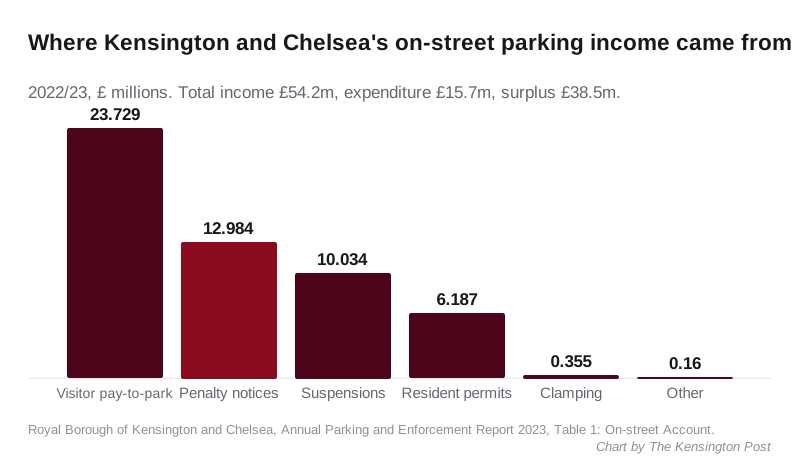
The council has not said what the pay support costs, but it has published what parking is worth to it. The most recent annual parking report covers 2022/23, and its on-street account shows:
- £54.249 million of income in total, against £15.735 million of expenditure, leaving a £38.513 million surplus.
- £23.729 million from pay-to-park visitor parking, the single largest line, and the reason the report gives for visitor parking being 44 per cent of income.
- £12.984 million from penalty charge notices, plus a further £800,000 from moving traffic contraventions.
- £10.034 million from parking suspensions and £6.187 million from resident permits.
- £4.972 million paid out that year for parking enforcement contracted services, the line the council is now proposing to increase.
The council issued 201,421 PCNs in 2022/23 and was paid on 161,499 of them.
By law, that surplus cannot simply be spent. Section 55 of the Road Traffic Regulation Act 1984 requires it to be rolled forward and applied to eligible purposes, which in London include highway maintenance, public transport, and environmental and recreational improvements. Anything left unapplied goes to the council’s Parking Reserve.
Penalty charges, clamping and removal fees are not set by Kensington and Chelsea at all. They are set by the Transport and Environment Committee of London Councils, the London-wide body. The council sets permit and visitor parking charges.
No consultation, and no equalities assessment
Officers concluded that public consultation was not required. Their reasoning is that the decision “relates solely to contractual and financial arrangements between the Council and its service provider”, does not change parking policy, charges or resident-facing services, and “therefore has no direct impact on the public or service users”.
An equality impact assessment was judged not to be needed either, and the report records no human resources implications for the council, since NSL employs the staff.
The report was written by Beau Stanford Francis, executive director of environment and resident services, and cleared by corporate finance, legal services and the director of communications and public affairs. The contact officer is Andy Vennard, the council’s head of parking services.
What it means for you
For now, nothing changes on the street. Enforcement carries on, the charges are the same, and your permit costs what it cost on 1 April. The point of the decision is to keep it that way.
If the dispute had gone the other way, the effect would have shown up quickly. The council’s own risk register for this decision lists the consequence as “extensive illegal parking that poses a hazard to other highway users”, and notes it has “no alternative provider available in the short term”. In 2023 that meant much reduced enforcement across the borough.
Three practical things worth knowing while this is live:
- Suspended bays are still enforced. A pay dispute does not change the rules on a bay with a suspension notice on it.
- If you get a PCN you think is wrong, the appeal route is unchanged. Our parking guide sets out the bays, the zones and the challenge process.
- Monthly permit subscriptions are still unavailable to set up. Since 27 August the council has not been able to take new monthly subscriptions or autorenewals, which it blames on a technical fault. Existing ones continue, and 3, 6 and 12 month permits can still be bought.
The next thing to watch is the modification notice. If the council publishes one under Regulation 72, it will be the first public indication of what this costs.
Sources
- Decision: Parking Enforcement, Proposed Strategy to Avoid Industrial Action KD1014284, Royal Borough of Kensington and Chelsea, published 23 September 2026, for the decision, the decision maker and the exempt appendix.
- Key decision report KD1014284R, Parking Enforcement, Avoidance of Industrial Action, 22 September 2026 for the five options, the 2023 dispute, the GMB claim, the contract dates, the Regulation 72 route, the risks and the consultation and equalities conclusions.
- Annual Parking and Enforcement Report 2023, Royal Borough of Kensington and Chelsea for the 2022/23 on-street account, the PCN totals, the enforcement contract cost, the Section 55 rules and the role of London Councils.
- Annual parking reports, Royal Borough of Kensington and Chelsea for the monthly permit subscription notice, last updated 17 September 2026.
Written from the council’s published decision and the report behind it. NSL Limited and the GMB union are welcome to respond and we will publish what they say.
Have your say