
A council paper models rises of 65% or 70% in its share of council tax for 2027/28, up to £793 more at band D. Consultation is due to open 12 November.
Kensington and Chelsea Council is considering raising its share of council tax by 65 or 70 per cent in April 2027. The options are set out in a finance report for the council’s Leadership Team, which meets on Wednesday 11 November.
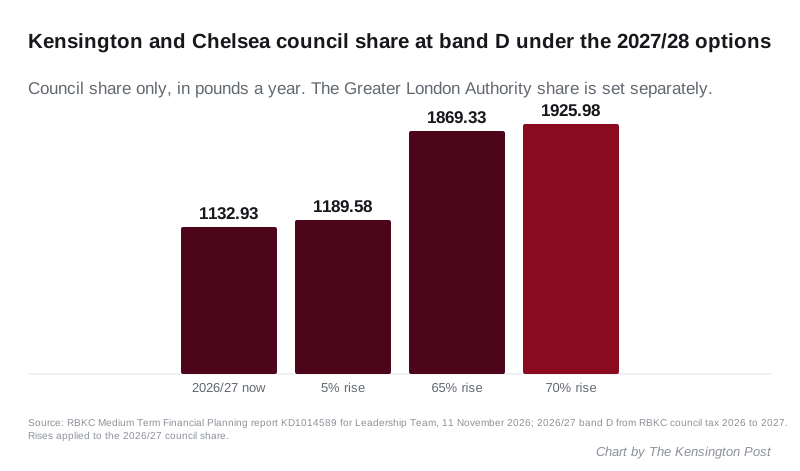
At band D, a 70 per cent rise would add £793.05 a year to the council’s share. It would go from £1,132.93 to £1,925.98. No level has been chosen yet: the report says no decision on council tax will be made until Full Council sets the budget in March 2027.
The report is the Medium Term Financial Planning paper, KD1014589, published with the agenda for the 11 November meeting. It was written by the council’s finance director.
Why the council is looking at this
The report blames the Government’s Fair Funding Review, which changes how money is shared between councils. The council says the new system will cut its resources by more than £100 million: £17.9 million this year and £91 million over 2027/28 to 2030/31. The report calls that “a reduction of over 40% of the Council’s controllable budget”.
Its figures for the four years from 2027/28 are:
- a budget gap of £178.0 million before any savings or council tax rise, £53.9 million of it in 2027/28
- £65.3 million of proposed savings, £23.7 million of them in 2027/28
- a remaining gap of £122.6 million after those savings
- a gap of £90.1 million still left if council tax rose by 5 per cent each year
The report says £29.7 million of the savings “has not yet been allocated to individual service budgets”, so their delivery is at risk.
The three options
Ministers have allowed Kensington and Chelsea and five other councils, four of them in London, to raise council tax by more than 5 per cent in 2027/28 and 2028/29 without a referendum. The report says ministers’ reason is that these boroughs have much lower band D bills than less affluent parts of the country. The council’s own band D charge is the fourth lowest in England, it says.
The report models three paths, each followed by 5 per cent a year from 2028/29:
| Option for 2027/28 | What the report says it does |
|---|---|
| 5% rise | Leaves a £90.1m gap over four years |
| 65% rise | Closes the gap except £1.1m, and puts £89.2m into a new reserve |
| 70% rise | Closes the gap entirely, and puts £109.6m into a new reserve |
The reserve would be called the Fair Funding Transition Reserve. The report says the council’s reserves have been run down by Grenfell, Covid, the cost of living crisis and the November 2025 cyber-attack. It also warns there is “limited precedent for increases of the scale being considered”, so collection rates could fall short of the forecasts.
What it would mean for each band
These are our own sums. We applied each rise to the council’s 2026/27 charges by band. They cover the council’s share only. The Greater London Authority sets its share separately, and it is £510.51 at band D this year.
| Band | Council share now | After 5% | After 65% | After 70% | Extra a year at 70% |
|---|---|---|---|---|---|
| A | £755.29 | £793.05 | £1,246.23 | £1,283.99 | £528.70 |
| B | £881.17 | £925.23 | £1,453.93 | £1,497.99 | £616.82 |
| C | £1,007.05 | £1,057.40 | £1,661.63 | £1,711.98 | £704.93 |
| D | £1,132.93 | £1,189.58 | £1,869.33 | £1,925.98 | £793.05 |
| E | £1,384.69 | £1,453.92 | £2,284.74 | £2,353.97 | £969.28 |
| F | £1,636.45 | £1,718.27 | £2,700.14 | £2,781.97 | £1,145.52 |
| G | £1,888.22 | £1,982.63 | £3,115.56 | £3,209.97 | £1,321.75 |
| H | £2,265.86 | £2,379.15 | £3,738.67 | £3,851.96 | £1,586.10 |
The report quotes a band D figure of £1,156.14 for the council’s share. That is £23.21 more than the £1,132.93 on the council’s published table, the same gap as the borough’s area average, which includes the garden square levies. Homes on a garden square pay that levy on top.
Households on the Council Tax Reduction Scheme would keep the same percentage discount, the report says. So the cash value of their support would rise with the bill.
What else is in the savings list
The savings appendix runs to dozens of lines. Among those residents would notice:
- £4 million more parking income from 2028/29
- £1 million from mobile number plate cameras to catch parking contraventions
- a trial of a pay-to-park option in underused resident parking bays
- shorter opening hours at the car pound
- a smaller Home Library Service, with more use of volunteers
- fewer “underutilised” sports activity programmes
- £150,000 from recovering the cost of seizing rental e-bikes
- grants to voluntary and community groups £567,000 lower than the last round
The finance report’s equalities section says a council tax rise would “disproportionately” affect residents on low incomes.
What it means for you
Nothing changes on your bill yet. The timetable in the report is:
- 11 November: Leadership Team decides whether to put the proposals out to consultation
- 12 November to 6 January: public consultation on the budget proposals
- 9 December: council tax base agreed
- 25 January: Overview and Scrutiny Committee looks at the draft budget
- 10 February: Leadership Team proposes the 2027/28 budget and council tax level
- 3 March: Full Council sets the budget and council tax
The consultation will be on the council’s website and in its resident newsletter, the report says. We will link to it when it opens.
Background: the council’s £108m fair funding fight and the budget day video from four council leaders.
Have your say