
Kensington and Chelsea patients leaving hospital for a care home face delays of about 10.4 days, against a 3 to 7 day target, as A&E visits rise.
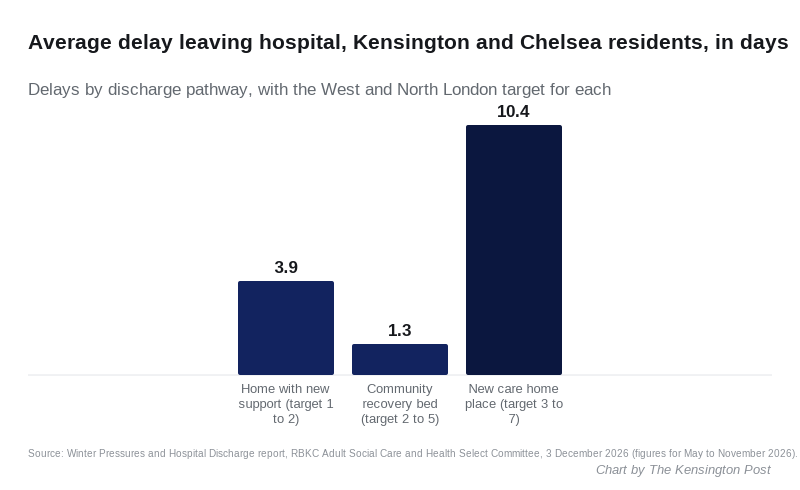
Kensington and Chelsea patients who need a new care home place are having their discharge from hospital delayed by about 10.4 days on average. The target for that delay is three to seven days.
The figure is in a report on winter pressures and hospital discharge for the council’s Adult Social Care and Health Select Committee. It meets at 6.30pm on Thursday 3 December at Kensington Town Hall.
The report also says attendances at Chelsea and Westminster Hospital’s emergency department are higher than in the same period last year. Its chart of weekly A&E visits by borough residents shows this year’s line above last year’s for most recent weeks.
Overview
- Care home discharges: about 10.4 days of delay, against a target of 3 to 7 days.
- Going home with new support: about 3.9 days of delay, against a target of 1 to 2 days.
- Short-term recovery beds: about 1.3 days, inside the 2 to 5 day target.
- Most discharges are simple: 91.7% are people going home with no new care needed.
- Winter money: the NHS in west and north London has set aside £20m for this winter across 13 boroughs.
- New local health teams start small in January or February.
How long people wait to leave hospital
The report sorts hospital discharges into four “pathways”. Each has a target for the average delay in getting patients out of hospital. The delay figures are for borough residents from May to November 2026.
| Where the patient goes | Share of discharges | Average delay | Target |
|---|---|---|---|
| Home, no new support | 91.7% | not given | none set |
| Home, with new care or rehabilitation | 6.5% | 3.9 days | 1 to 2 days |
| A community recovery bed | 0.9% | 1.3 days | 2 to 5 days |
| A new care home or nursing home place | 0.9% | 10.4 days | 3 to 7 days |
The report links the delays to the busier emergency department and to other pressures. It lists the main reasons patients cannot leave on time:
- more complex health and care needs
- too few care providers able to meet some needs
- homes that are unsuitable or need repairs or adaptations
- equipment and transport
- family choices about longer-term care
- mental capacity and safeguarding checks
- immigration status, where people have no recourse to public funds
- information and funding decisions passing between organisations
The winter plan
The West and North London Integrated Care Board, which plans NHS services for 13 boroughs, has committed £20m of one-off money for winter 2026/27. The report says £4m of it goes to GP and other primary care, for extra urgent appointments, vaccinations and care planning.
The board’s winter readiness plan, attached to the report, sets out each hospital trust’s commitments. For Chelsea and Westminster these include:
- seeing at least 80% of A&E patients within four hours, and more than 82% by year end
- growing same day emergency care to 1,000 patients a month at each site
- a frailty service at the front door and a command centre watching patient flow
New neighbourhood health teams
Kensington and Chelsea and Westminster have been picked as a neighbourhood health “accelerator site”, according to the report. That means extra funding to bring GPs, community and mental health services, hospitals, council social care and voluntary groups into joint local teams.
The teams will focus first on adults with complex needs. Across Kensington, Chelsea and North Paddington, 14,029 patients are in that group. They have an average age of about 62. The report says 11.8% are experiencing homelessness.
There will be four teams in this part of the area: two covering North Kensington, Chelsea and North Paddington, and two covering South Kensington and Chelsea. Each borough starts with one team supporting small numbers of residents from January or February. The rest follow over 12 to 18 months.
The report is cautious about what this winter will show. It says “an immediate reduction in overall hospital demand should not be assumed during the first winter”.
What it means for you
If someone in your family is in hospital and may need care afterwards, the report says hospital staff should identify that and refer them to the council’s hospital social work service. It screens and assesses the patient and plans the discharge, involving families and unpaid carers where appropriate.
The board’s plan lists other routes to care besides A&E this winter: more bookable NHS 111 appointments, Pharmacy First at local chemists and urgent dental care. It is also running flu, COVID-19, RSV and pneumococcal vaccination programmes.
The committee meets in public on 3 December in Committee Room 1 at Kensington Town Hall, and the agenda and papers are online. The report is for information, and councillors are asked for their questions on how the NHS and council work together on discharge.
Have your say