
Up to four more forms of entry may need to go from Kensington and Chelsea primary schools by 2029/30, a review says. Closures are not ruled out.
Overview
Kensington and Chelsea may need to cut up to four more forms of entry from its primary schools by 2029/30, an independent review says. A form of entry is one class of 30 children a year. The review says amalgamations and closures must be considered once other options run out.
The review will be discussed by the borough’s Schools Forum on Monday 16 November. No school is named as a candidate for closure, and nothing has been decided.
The review was written by Isos Partnership, which carried out the council’s last review in 2020. It is published with the Schools Forum agenda. The council’s cover report asks the forum whether it endorses the approach or wants changes first.
How far pupil numbers have fallen
Primary pupil numbers in the borough fell by around 18 per cent between 2018/19 and 2025/26, the review says. That is among the steepest drops in London. Across inner London the fall was over 12 per cent, and across England just over 3 per cent.
The review gives several reasons:
- the national fall in the birth rate
- the cost of living in inner London
- changes in migration after Brexit
- families moving out of central London during and after Covid
Many of the people interviewed for the review also blamed the lack of affordable and social housing in the borough.
What has already been cut
Schools have already removed 4.5 forms of entry since 2020, or 135 Reception places. The review lists the changes:
- St Mary’s Catholic Primary School cut its intake from 60 to 30 in September 2023
- Oxford Gardens Primary School cut from 60 to 45 in 2024, then to 30 in September 2026
- Ark Brunel Academy cut from 60 to 30 in September 2025
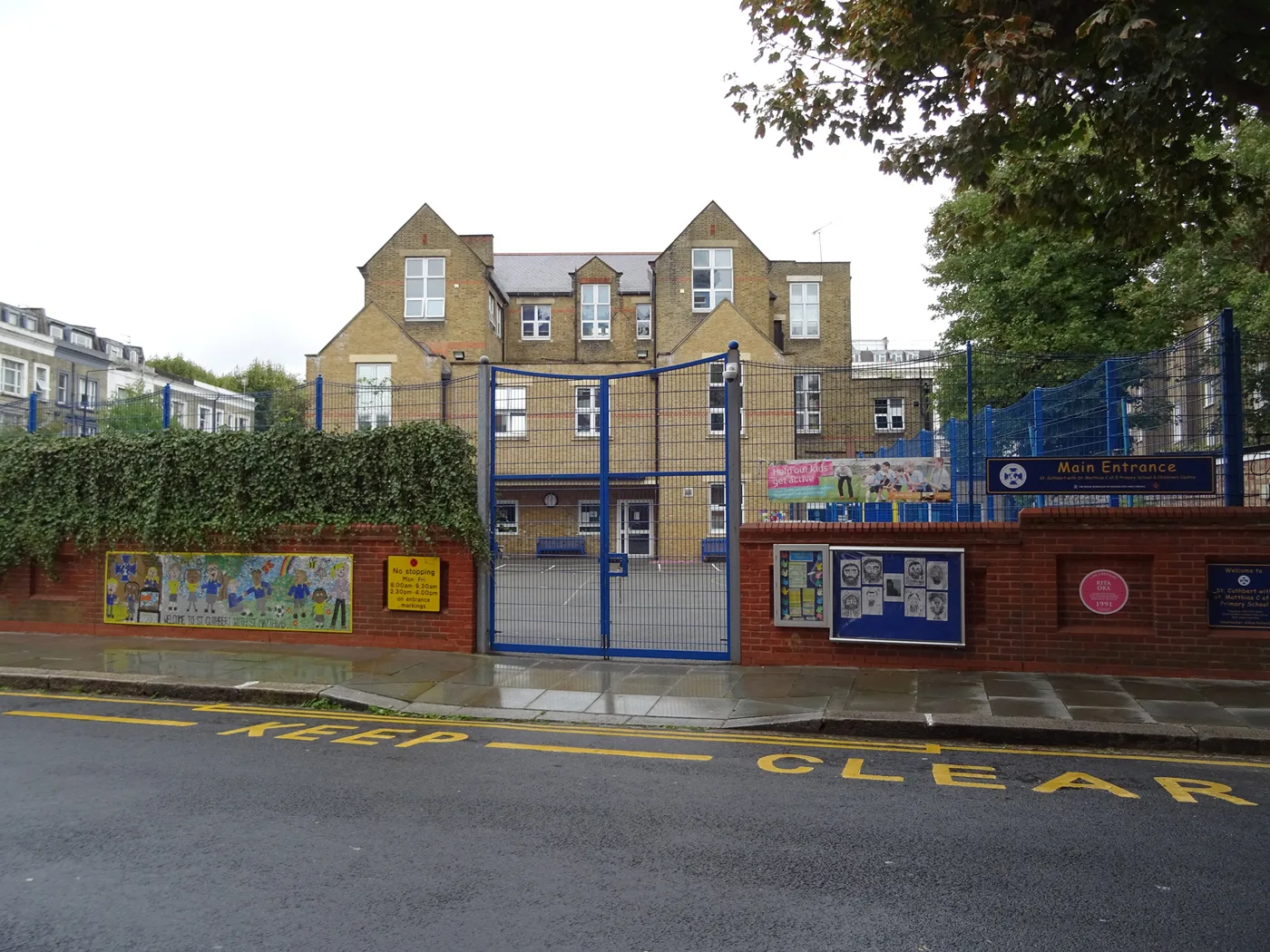
- St Cuthbert with St Matthias CE Primary School closed in October 2025
- Bevington Primary School is consulting on a cut from 45 to 30 from September 2027
The governing bodies of Park Walk and Ashburnham primary schools are consulting on a proposal to amalgamate from September 2027. The review says that remains subject to the consultation and later decisions.
The numbers now
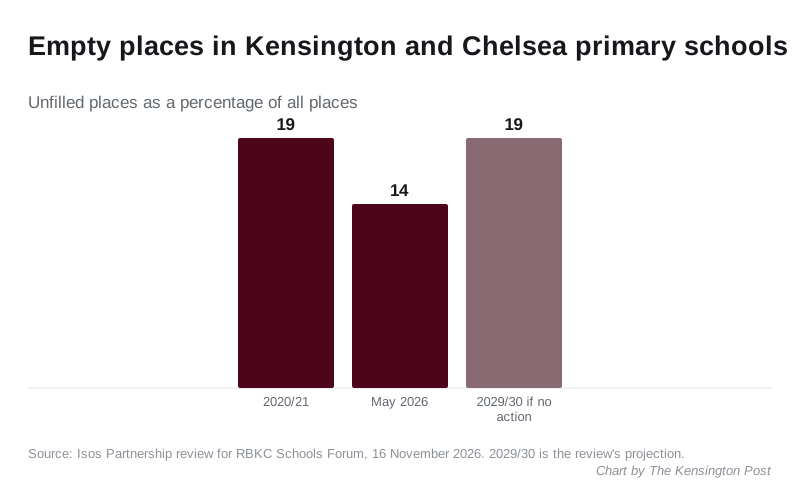
In 2020/21 the borough’s primary schools had 1,512 empty places out of 8,015, a 19 per cent surplus. At the May 2026 census there were 971 empty places out of 6,860, or 14 per cent.
The surplus is much higher in the north of the borough:
| Planning area | Pupils now | Places now | Projected change by 2029/30 | Surplus by 2029/30 if nothing changes | Forms of entry to remove for a 10% surplus |
|---|---|---|---|---|---|
| North | 2,644 | 3,290 | -140 | 24% | 2 to 3 |
| South | 3,245 | 3,570 | -221 | 15% | 1 to 2 |
| Borough | 5,889 | 6,860 | -361 | 19% | 3 to 4 |
The vacancy rate in May 2026 was 19.6 per cent in the north and 9.1 per cent in the south. The table’s projections add up to 361 fewer pupils. The review’s summary quotes a Greater London Authority projection of 470 fewer primary pupils by 2029/30.
There is little room left for simple intake cuts, the review says. Just over two thirds of the borough’s primaries already take one class a year. Four of the five two-class schools are near full, with vacancy rates of 5 per cent or below.
School finances
Only two of the borough’s 23 council-maintained primaries were in deficit at the end of 2025/26. Average reserves rose from £147,000 in 2020/21 to £222,000. But the review says more schools are forecast to be in deficit by the end of this financial year.
The council can no longer run a falling rolls fund, the review explains. Government rules only allow that money where extra places will be needed within three to five years, and that is not the case here.
What the review recommends
The review sets out four kinds of action, in this order:
- Stabilise individual schools, with tighter budgets and further intake cuts.
- Partner with other schools. Ten of the borough’s primaries are already in federations.
- Share sites with other services, such as nurseries, childcare and family support.
- Amalgamate, close or convert schools once the other options have been tried.
It points to the former St Cuthbert with St Matthias site in Earl’s Court, which now houses a family hub, as an example of a closed school reused for the community. It says selling a site for housing is hard: a school must have stood empty for at least eight years first.
It also proposes a “risk matrix” to score each school on empty places, first-choice applications, finances and results. The review says a high score does not automatically make a school a candidate for closure.
The proposed timetable
The review suggests the council should have a preferred option for its most at-risk schools by the end of the 2026/27 school year:
- Spring term 2027: risk scores completed and shared confidentially with schools
- Summer term 2027: meetings with schools, governors and the dioceses in each area
- Summer and autumn terms 2027: preferred options tested, then formal consultation by the bodies responsible
The council should also consider using its intervention powers, the review says, for any school with an unlicensed deficit and no workable recovery plan by the end of May 2027.
What it means for you
Nothing changes for any school yet. Any amalgamation or closure would need a formal consultation with the school’s community first. For a council-maintained school the council makes the final decision. For an academy it is the Department for Education.
The Schools Forum meets at 5pm on Monday 16 November. Its members include headteachers and governors from across the borough. Park Walk and Ashburnham families can respond to their schools’ own amalgamation consultation, which the review describes as under way.
Have your say