
Police seized 90 vehicles worth over £8m across Kensington, Chelsea and Hyde Park in one weekend, days after a High Court order banned car meets until 2027.
Police seized 90 vehicles worth more than £8 million in Kensington, Chelsea and Hyde Park over the weekend of 7 to 9 August, the largest haul in the five years the Metropolitan Police has been running the operation. (Metropolitan Police, 10 August 2026)
The single most valuable vehicle taken was a Ferrari Monza SP2, one of 499 built and worth about £3.7 million. The Met says it had been in the country for a day. It was seized because the driver had no insurance and was not driving in accordance with a licence, holding only a provisional one.
The weekend was not an isolated crackdown. It came nine days after a High Court order against car meets took effect across the Knightsbridge side of the borough, and six weeks after Parliament removed the requirement for police to warn a driver before taking their car away. Both changes widened what officers can do on the spot, and the Met says this was the highest number and value of vehicles taken in the operation’s five-year history.
What was seized, and under what power
Of the 90 vehicles, 15 were taken under antisocial behaviour legislation rather than for insurance or licence offences. That distinction matters, because it is the part of the law that changed this summer.
The power is section 59 of the Police Reform Act 2002, which lets a uniformed officer stop and seize a vehicle being driven in a way that causes alarm, distress or annoyance to the public. Until this year an officer normally had to issue a warning first and could only seize the car if the behaviour continued. Subsections 59(4) and 59(5), which contained that warning requirement, were omitted on 29 June 2026 by sections 8(1) and 255(1) of the Crime and Policing Act 2026. The warning stage no longer exists.
The Met deployed 120 officers on the operation, 95 of them from the Special Constabulary and the Vehicle Enforcement Team, working with the Motor Insurers’ Bureau. Alongside Kensington and Chelsea, officers worked at Hyde Park, Park Lane, Wellington Arch, Sloane Square and Vauxhall Bridge.
Special Chief Inspector Geoff Tatman said: “We regularly hear from local people who are fed up with people driving cars dangerously.” The force said officers also made four arrests over the weekend on matters unrelated to driving. No one has been named and an arrest is not a conviction.
The injunction that now covers Knightsbridge
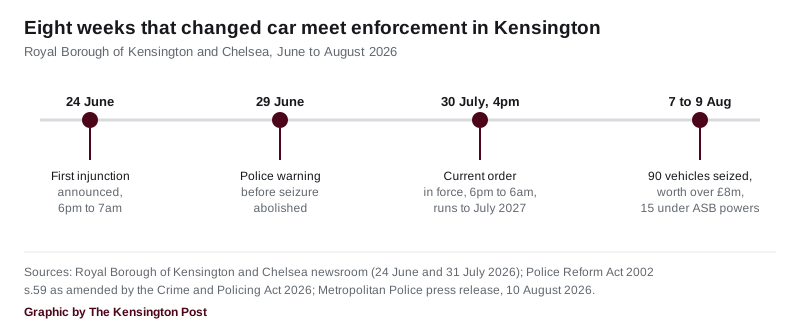
On 30 July 2026 at 4pm, a High Court injunction obtained jointly by Kensington and Chelsea Council, Westminster City Council and the Metropolitan Police came into force. It runs until the first available court date after 19 July 2027. (Royal Borough of Kensington and Chelsea, 31 July 2026)
In this borough it covers the Brompton and Hans Town ward. In Westminster it covers Hyde Park, St James’s, West End, Knightsbridge and Belgravia. Between 6pm and 6am, in a gathering of two or more people, the order forbids driving at excessive speed or otherwise dangerously, driving in convoy, racing, doing stunts, sounding horns, playing amplified music, revving engines and obstructing other road users. It also forbids promoting, organising or publicising such an event, which brings the people filming and posting these meets inside its scope.
A power of arrest under section 27 of the Police and Justice Act 2006 attaches to the order. Breaching it is a contempt of court, which can mean arrest, imprisonment, an unlimited fine or seizure of assets.
That order followed an earlier injunction the council announced on 24 June, which covered “the Brompton and Hans Town ward, including Exhibition Road which has been significantly impacted by nuisance driving”, and ran between 6pm and 7am. (Royal Borough of Kensington and Chelsea, 24 June 2026)
Cllr Johnny Thalassites, the council’s lead member for resident services, planning and enforcement, said at the time: “Car meets and street cruising are not just harmless fun. They bring noise, disruption and danger to residential areas and show a complete disregard for residents who should not have to put up with their roads being used as racetracks.”
What it means for you
If you live in Brompton and Hans Town, the order is the strongest tool available and it works on evidence you can supply. The council says the injunction is enforced using CCTV, social media and witness statements, so a dated note of what you heard, and from where, is useful in a way that a general complaint is not.
If you drive a car here, the warning stage is gone. Before this summer, a first instance of driving that annoyed or alarmed people would usually get you a section 59 warning. Since 29 June it does not have to. Fifteen of the 90 cars taken in August went on that basis.
Check your insurance covers the car you are actually driving. Fifteen of the 90 went under antisocial behaviour powers. The remaining 75 were taken in an operation the Met says was aimed at uninsured drivers as much as at dangerous ones, and a car seized that way costs recovery and storage fees on top of the offence itself.
The boundary is a ward boundary, not a street. The order binds conduct inside Brompton and Hans Town and the five named Westminster wards. Noise from a car meet two streets outside it is not covered by this injunction, though the council’s Public Space Protection Order powers and section 59 still apply borough-wide.
Roadworks, closures and travel changes across the borough are tracked on our Kensington roadworks and travel page, and current Tube and rail information is on our Kensington travel page.
Have your say